
KYC as a Service: What it is, and when relying on a third party actually works

James Owusu
The pitch for KYC as a Service (KYCaaS) is seductive: stop building and maintaining your own due diligence, hand it to a specialist, and never think about it again. For some firms, that’s the right choice. But there’s one line in the UK Money Laundering Regulations that the slick KYCaaS marketing tends to skip, and it changes everything about how you should buy it: even when you rely on a third party, you remain liable for the check.
I spent eight years doing client due diligence inside financial services before founding this company, so I’ve been on both sides of that arrangement, relying on others’ checks, and being the party others relied on. Here’s what KYC as a Service actually is, where it earns its place for a UK-regulated firm, and the trap to avoid.
What KYC as a Service is
KYC as a Service (KYCaaS) is a delivery model where a third-party provider carries out identity verification, customer due diligence and AML screening for you. This is usually done via an API, an app, or a managed service, on a subscription or per-check basis, instead of you building and running that capability in-house.
In practice, it covers some or all of: verifying a customer’s identity, screening them against sanctions and politically-exposed-person lists, establishing a source of funds, and monitoring for changes over time. The selling point is that you don’t maintain the data feeds, the verification technology or the regulatory plumbing yourself. You consume the outcome.
KYCaaS vs reliance: The distinction that decides your liability
This is the part worth paying attention to, because two very different things often get sold under the same banner.
Buying KYC as software/a managed service means the provider runs the checks, but you are still the one performing due diligence; you’re just using their tools and people to do it. You hold the result of your risk assessment, and you stand behind it.
Reliance is a specific legal arrangement under Regulation 39 of the Money Laundering Regulations 2017. It lets one regulated firm rely on customer due diligence already carried out by another regulated person, avoiding duplicate checks on a client who’s already been verified elsewhere. It has hard conditions: the third party must be a regulated firm (in the UK or an equivalent regime), there must be a written agreement, and they must hand over the underlying CDD records within two working days of a request.
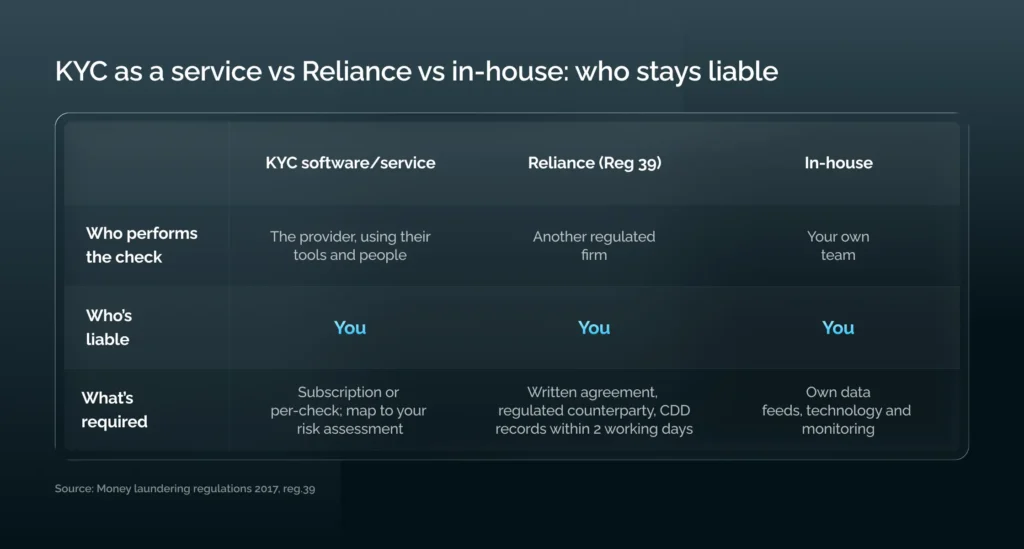
In both cases, you remain liable for any failure. Outsourcing the work never outsources the responsibility. If the check was weak and a regulator comes asking, it’s your firm that answers, not your vendor.
So when someone sells you ’KYC as a Service’, the first question isn’t about price or speed. It’s which of these am I actually buying, and what does it leave on my plate?
When KYC as a Service makes sense for a regulated firm
It makes sense in a few clear situations:
- You’re onboarding more clients than your team can check by hand: A growing estate agency or conveyancing practice hits a wall where manual due diligence simply doesn’t scale. A service model absorbs the volume.
- You don’t want to own the technology and data feeds: Sanctions lists change daily, verification methods evolve, and biometric checks need constant maintenance. Buying that as a service is usually cheaper and more current than building it.
- The same client keeps being checked twice: Where a client has already been through proper CDD with another regulated firm, common in property and legal chains, reliance under Regulation 39 can remove the duplicate if the conditions are met.
- You need defensibility, not just a result: A good provider gives you a complete, timestamped record you can hand to a supervisor. That matters when the cost of an incomplete file is real: HMRC fined more than 250 estate agency businesses for AML failures in a single recent period, and the SRA found roughly one in three law firms it reviewed were not compliant.
When it doesn’t: The trap to avoid
The failure I see most often isn’t choosing the wrong provider. It’s treating ‘as a service’ as ’off my desk’.
A firm signs up, assumes the provider now owns compliance, and stops paying attention to its own risk assessment, its own monitoring, and its own audit trail. Then a check turns out to be thin, or a client’s circumstances change, and nobody’s watching, and the firm discovers, too late, that the liability never moved. The regulation is unambiguous on this; the marketing rarely is.
There’s a second trap. Some KYCaaS providers verify identity beautifully and stop there, leaving you to handle the source of funds and any client money separately, by hand. That’s the same disconnected, hand-stitched process that causes problems with in-house KYC, just with an invoice attached. The value of a service model collapses if it only covers the easy step.
The point of buying KYC as a service is to make your own compliance stronger and more defensible. If it makes you complacent or only covers part of the job, it’s doing the opposite.
How to choose a KYC as a Service provider
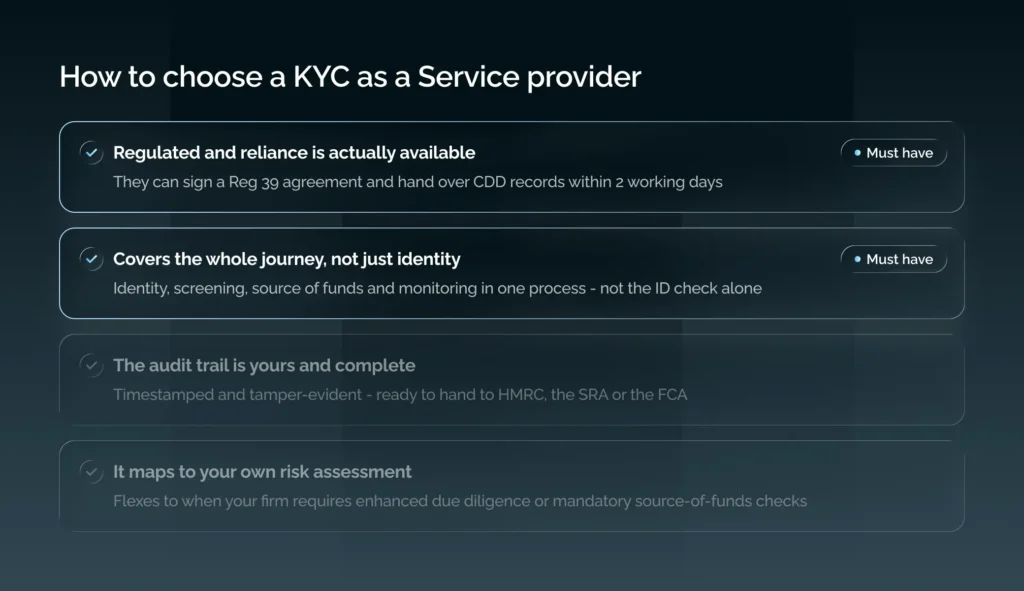
1. Confirm they’re regulated and that reliance is actually available
If you intend to rely on their checks under Regulation 39, they must be a regulated firm and willing to sign a written reliance agreement and produce CDD records within two working days. Plenty of ‘KYCaaS’ vendors are software companies, not regulated firms, fine as tools, but you can’t rely on them in the legal sense.
2. Check it covers the whole journey, not just identity
Identity verification, sanctions and PEP screening, source of funds, and ongoing monitoring should live in one process. If the source of funds and client money are left for you to handle manually, you haven’t removed the risky seam; you’ve just moved the ID check.
3. Make sure the audit trail is yours and is complete
You need to be able to show what was checked and when, on demand. Confirm you get a timestamped, tamper-evident record you can hand to HMRC, the SRA or the FCA, not a results screen you’d have to reconstruct later.
4. Map it to your own risk assessment
A service running its own generic defaults isn’t enough. It has to flex to when your firm requires enhanced due diligence or mandatory source-of-funds checks. Your risk appetite governs the check, even when someone else performs it.
Where Kord fits in
Kord is built for UK-regulated businesses includingestate agents, conveyancers, law firms, lenders and brokers, and we deliberately offer both models, because firms need different things.
If you want to run your own due diligence faster, our platform handles identity, AML and PEP/sanctions screening, source of funds checks and client due diligence in one workflow, and keeps client funds inside the same closed loop rather than as a separate manual step.
If you want to rely on checks already done, Kord Reliance is built specifically for Regulation 39: under MLR 2017, your firm can rely on Kord’s customer due diligence, remove duplicate checks, and still satisfy your AML obligations, with the written agreement and records access the rule requires.
What I won’t tell you is that any of this takes the responsibility off your shoulders. It doesn’t, and any provider who implies otherwise is the one to walk away from. What it does is make the check fast, complete and defensible, so that when you’re held liable, you’ve got nothing to worry about.
Change how you think about compliance
Stop asking ‘how do I get KYC off my desk?’ Ask ‘how do I make the check I’m still liable for as strong and as provable as possible?’. KYC as a Service answers the second question well, and the first one not at all, because the first question has no honest answer under UK law. Buy it for defensibility and scale, not to stop thinking about compliance.
If you want to work out which model fits your firm, run it yourself, or rely on a third party, book a demo, and we’ll map it to how you onboard.
Frequently asked questions
It’s a model where a third-party provider carries out identity verification, customer due diligence and AML screening for you, via an API, app or managed service, usually priced per check or by subscription, so you don’t build and maintain that capability in-house.
It’s a model where a third-party provider carries out identity verification, customer due diligence and AML screening for you, via an API, app or managed service, usually priced per check or by subscription, so you don’t build and maintain that capability in-house.
Using KYC software or a managed service means you’re still the firm performing due diligence, just with someone else’s tools. Reliance (Regulation 39) is a legal arrangement to rely on CDD, another regulated firm has already done. It needs a written agreement, a regulated counterparty, and records produced within two working days.
Yes, particularly where onboarding volume outstrips a manual team or where clients are repeatedly re-checked across a property or legal chain. The key is choosing a provider that’s regulated, covers the source of funds as well as identity, and gives you a complete audit trail.
Confirm they’re regulated if you plan to rely on their checks, check the service covers the whole journey (identity, screening, source of funds, monitoring), make sure you own a complete audit trail, and confirm it maps to your own risk assessment rather than a generic default.