
KYC automation: How regulated firms cut onboarding from weeks to minutes

James Owusu
I spent eight years running client due diligence inside financial services before I started this company. The thing I remember most isn’t the regulation but the waiting. A regulatory question that should take seconds to answer would sit in an inbox for a week, then another, while someone chased a passport scan and a bank statement and tried to line them up by hand. The check wasn’t hard. The process around it was broken.
That gap is where most KYC automation falls short. It speeds up the one step that was already the easiest to fix, reading an ID document, and leaves everything around it exactly as slow and exactly as risky as before. If you run an estate agency, a conveyancing practice or a law firm in the UK, that’s the version of ‘automation’ you’ve probably been sold. This is what it should look like, and where potential risks hide.
What KYC automation really is
KYC automation is the use of software to carry out the steps of knowing your customer: verifying who someone is, checking them against sanctions and PEP lists, establishing where their money comes from, and monitoring that picture over time, without a person doing each task by hand.
You already know what the manual version costs you: an onboarder collecting documents over email, eyeballing a driving licence, copying details into a spreadsheet, and filing it all in case the regulator ever asks. Automation replaces those steps with biometric identity checks, automated screening against live data, open-banking source of funds collection, and an audit trail that builds itself. The point isn’t speed for its own sake. It’s that a connected, automated process leaves fewer gaps for fraud and for regulatory failure to slip through.
KYC automation vs KYC outsourcing
These two get used interchangeably, and they’re not the same thing.
KYC automation means you keep ownership of the process and use software to run it faster and more consistently. The checks happen inside your workflow, on your firm’s risk appetite, under your control.
KYC outsourcing, often sold as KYC as a Service, means a third party performs due diligence, and you rely on their work. Under UK rules, that’s a specific, regulated arrangement with specific limits, and one fact survives it: you remain liable. Outsourcing the task does not outsource the responsibility.
Most regulated firms want automation, not full outsourcing; they want their own process to be quick and defensible. Some want to rely on a trusted third party for parts of it. The right answer depends on your firm, and it’s worth being clear which one you’re actually buying.
Why this matters now: The regulators have stopped accepting ‘good enough’
The cost of getting this wrong used to be mostly theoretical. It isn’t anymore.
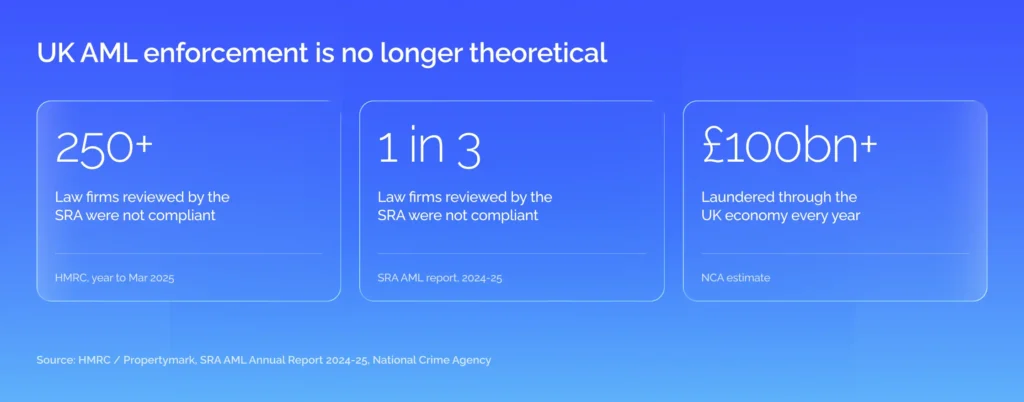
In the year to March 2025, HMRC fined more than 250 estate agency businesses for anti-money laundering failures, with penalties from £1,500 to over £50,000; its most recent published list alone hit 170 estate agency businesses with £835,842 in penalties. On the legal side, the Solicitors Regulation Authority found that only 112 of the firms it reviewed in 2024–25 were fully compliant, roughly one in three were not compliant at all, and it nearly doubled its proactive AML engagements to 935 in a year. Fines followed: more than £565,000 by late 2025.
The backdrop is scale. The National Crime Agency estimates more than £100 billion is laundered through the UK economy every year, and supervision of professional services AML is being consolidated under the FCA, a regulator that tends to lead with enforcement. Firms that have coasted on partial, manual processes are exactly the ones that look exposed under that kind of scrutiny.
Manual KYC is also quietly expensive in a way that never shows up as a fine. UK financial services firms spent £38.3 billion on financial crime compliance in 2023, up 12% in a single year. And it costs you clients: in Thomson Reuters research, some corporate onboarding ran to 100 days, and a share of clients walked away rather than sit through it.
The problem most KYC automation misses
For a regulated firm, risk almost never exists inside a single check, but in the seams between checks.
Identity sits in one tool. Source of funds sits in another, or in a client’s emailed PDF. Client money moves through a third system, or a manual bank transfer. Each step might be fine on its own. But nobody owns the join, and the join is where fraud gets in: a verified identity attached to funds nobody actually traced, a payment released before the source of funds flag was cleared, an audit trail assembled after the fact from four different places.
Automating one step faster doesn’t close that gap. It can widen it by making the fast step feel finished while the slow, risky steps still happen by hand. When I was running due diligence, identity and money were two separate workflows handled by two separate teams, connected by people. That hand-off was the single biggest source of risk I saw, and it’s why I believe automation only pays off when it connects the steps rather than just accelerating one of them.
So, firms need to look beyond automation, and instead ask how they can build a process that encompasses identity, funds, and money in one.
How to automate KYC properly
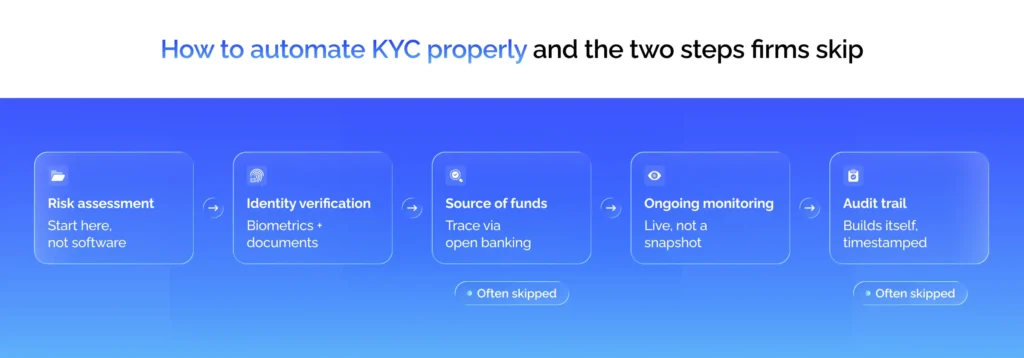
1. Start from your risk assessment, not the software
Your firm-wide and matter-level risk assessments define what good due diligence looks like for you, what’s standard, what triggers enhanced checks, and when a source of funds is mandatory. Automate to that, not to a vendor’s default. Software that can’t flex to your risk appetite will either over-check low-risk clients (friction) or under-check high-risk ones (liability).
2. Automate identity verification with biometrics and document checks together
Replace the emailed passport scan with a guided check: the client photographs their ID, takes a liveness selfie, and the two are matched automatically against the document and against sanctions and PEP data. This is the step everyone automates first. Just don’t let it be the only one.
3. Connect the source of funds to the same workflow
This is where AML actually gets tested, and where manual processes leak. Use open banking so a client can connect their account and have funds traced automatically, rather than emailing statements you then read by hand. A verified identity attached to untraced money is not a completed check.
4. Make monitoring continuous, not a one-off
A client who was clean at onboarding can appear on a sanctions list next month. Automated, ongoing screening against PEP and sanctions lists turns due diligence from a snapshot into something live, which is increasingly what supervisors expect to see.
5. Capture the audit trail automatically
If you can’t show what you checked and when, you didn’t really check it as far as a regulator is concerned. The workflow should produce a timestamped, tamper-evident record as a by-product of doing the work, not a folder someone rebuilds the night before an inspection.
Where Kord comes in
I’ll be straight about what we do and don’t do. Kord is built for UK-regulated businesses: estate agents, conveyancers, law firms, lenders and brokers, not for banks running millions of retail checks. We built it because the closed-loop problem I kept hitting in financial services had no off-the-shelf answer for these firms.
Kord runs identity verification, AML and PEP/sanctions screening, source-of-funds checks and client due diligence inside one workflow, and this is the part that’s hard to find elsewhere; it keeps client funds in the same closed loop, so identity and funds aren’t stitched together by hand. The client downloads one app, completes one journey, and you get back a single report that flags anything that needs a human’s attention.
John German Estate Agents put it more plainly than I could: Kord was ‘a comprehensive one-stop solution to AML, the ID check, the PEP check, the sanctions check, and then all the proof of funds as well, which we find is invaluable for us in saving time’.
The change to make
Stop thinking about KYC automation as making your slowest check faster. Think about it as removing the hand-offs where risk actually lives. A firm that automates one step still owns five manual gaps. A firm that connects identity, funds and money into one auditable process owns none of them and onboards in minutes instead of weeks as a side effect.
If you want to see what that looks like for your firm, book a demo and bring your messiest onboarding case. We’d rather show you the join than talk about it.
Frequently asked questions
Mostly, but not entirely. Identity verification, screening, source-of-funds collection and monitoring can all run automatically. UK regulations still expect human judgement on higher-risk cases and unusual flags, so the goal is to automate the routine 80–90% completely and route genuine exceptions to a person, not to remove people from the decision.
Yes, when it’s built to the Money Laundering Regulations 2017 and to your own risk assessment. Automation doesn’t change what you’re obliged to check; it changes how reliably you check it and how easily you can prove it. A timestamped audit trail usually makes you more defensible to a supervisor, not less.
A connected automated workflow typically takes a client minutes to complete, versus the days or weeks a manual back-and-forth can run to. The bigger time saving is on your side: no chasing documents, no manual data entry, no rebuilding an audit file later.
It varies by provider and volume, but the more useful comparison is against the cost of the manual process. That means staff hours spent onboarding, clients lost to slow journeys, and the penalty risk of an incomplete file. UK firms’ financial-crime compliance costs rose 12% in a single year; automation is one of the few levers that push the other way.
Automation means you run your own due diligence faster with software. KYC as a Service means a third party performs it, and you rely on their work under a regulated arrangement useful in some cases, but you stay liable either way. More on that in our guide to KYC as a Service.