
Source of funds in conveyancing: What good actually looks like

James Owusu
Before I started Kord, I spent eight years running client due diligence inside financial services. The thing that struck me, over and over, was how often a serious regulatory question got answered with a pile of documents, a chain of emails, and a few weeks of waiting. Everyone collected paper. Far fewer people actually read it and asked whether it made sense.
Nowhere is that gap more exposed than in the source of funds in conveyancing. It’s the check most likely to be done badly, and the one regulators are now most likely to fine you for. And the failure is rarely that firms didn’t ask. It’s that they asked, filed the answer, and never tested it.
What a source of funds check is
Source of funds asks where the specific money for this transaction came from, and whether you can prove it isn’t the proceeds of crime. For a house purchase, that means tracing the deposit and the balance to a legitimate, evidenced origin: salary, a property sale, savings built over time, or a gift.
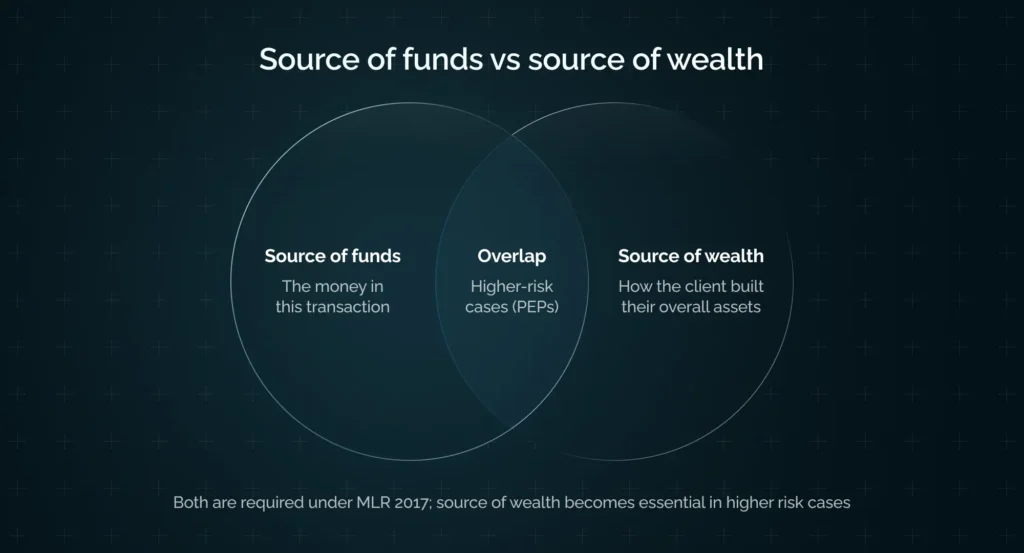
It’s worth separating two things that get muddled. The source of funds is the money in this transaction. The source of wealth is the bigger picture: how the client accumulated their overall assets. They’re distinct requirements under the Money Laundering Regulations 2017, and they overlap in higher-risk cases. You always need to understand the source of funds where the risk requires it; you need a source of wealth when, for example, the client is a politically exposed person or the funds raise questions you can’t answer from the transaction alone.
The conveyancing wrinkle that catches people out is gifted deposits. When part of the money comes from a parent or friend, a ’giftor’, their funds need checking and evidencing too. A clean check on the buyer is worthless if the £40,000 gift behind it is unexplained.
Proof of funds vs source of funds: Not the same thing
Buyers and a surprising number of professionals use these interchangeably. They’re different checks, at different points, for different reasons.
Proof of funds shows that the buyer has the money: a bank balance, a mortgage agreement in principle, or an investment statement. It’s usually asked for early, often by the estate agent at the offer stage, to confirm the buyer can actually complete.
The source of funds proves where that money came from. It’s an anti-money-laundering requirement; it sits with the conveyancer or solicitor, and it’s about legitimacy, not availability. You can have impeccable proof of funds and still fail a source of funds check; having £300,000 in an account tells me nothing about how it got there.
But confirming the buyer is good for the money is the easy part. The regulated, fineable part is evidence that the money is clean. That’s the part this guide is about.
Why anti-money laundering is the check regulators care about most
Property is the launderer’s favourite vehicle. The National Crime Agency estimates that up to £10 billion is laundered through UK property every year, and Transparency International has linked over £11 billion of suspicious wealth to UK real estate since 2016. Conveyancers sit directly in that path: trusted professionals who can move large sums in a single transaction and make them look legitimate. That’s exactly why criminals target them, and exactly why the SRA is watching.
The enforcement has teeth. In 2025, the SRA fined 35 firms more than £565,000 for AML failings, with incomplete source of funds and source of wealth work among the top reasons for referral. These aren’t abstract cases. Rollits LLP was fined £15,168 after it couldn’t establish the source of funds on four residential conveyancing transactions. Four files. Yes, that’s all it takes.
The real failure: Collecting evidence without assessing it
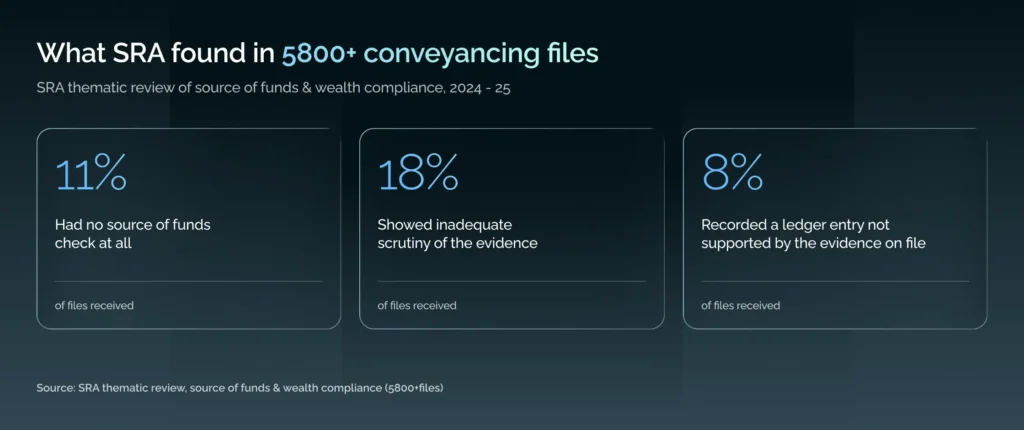
When the SRA ran its thematic review of source of funds and wealth compliance, it reviewed more than 5,800 files from 2024–2025. It found that 11% lacked source-of-funds checks altogether, 18% showed inadequate scrutiny, and in 8% of cases, the source of funds recorded on the ledger wasn’t even supported by the evidence on file.
Read that last one again. The firm had the documents, but the documents didn’t match what they’d written down, and nobody noticed.
The regulator’s own summary of the problem is blunt: firms’ often collect but do not assess evidence. A bank statement in the file alone is not a source of funds check, but the raw material for one. The check is the judgment: does this money, from this person, for this transaction, actually add up?
MLR 2017 doesn’t ask you to gather paperwork. It asks you to scrutinise to satisfy yourself that the transaction is consistent with what you know about the client.
This is the gap I built Kord to close. Most firms aren’t negligent; they’re drowning. Time and resource pressure, which the SRA explicitly named as a driver, especially for smaller firms, pushes teams to collect-and-file because assessing properly by hand is slow.
How to really run an anti-money laundering check
A check that survives an SRA inspection and catches dirty money does four things, in order:
1. Establish the full picture before money moves
Identify every funding stream up front: deposit, mortgage, savings, sale proceeds, gifts. Name the giftors. You can’t assess money you didn’t know was coming.
2. Get evidence that’s proportionate to risk, then actually read it
A first-time buyer using a documented salary and a Help to Buy ISA is not the same risk as an all-cash purchase funded from an overseas account. Match the depth of evidence to the risk, and scrutinise it: do the dates, amounts and names reconcile with the ledger and with what the client told you?
3. Resolve the things that don’t add up
A £50,000 deposit appearing in a current account two weeks ago is not explained by a screenshot. Chase it down or escalate it. The 8% of files where the ledger didn’t match the evidence are firms that raised a question instead of answering it.
4. Evidence of the assessment, not just the documents
Record what you concluded and why. If the SRA asks, ’existence’ of a policy isn’t enough; they want to see the judgement applied and documented. Make the reasoning visible.
How Kord makes anti-money laundering checks easier for conveyancers
This is the workflow Kord is built for. Our source of funds checks pull verified financial data and analyse it, so your team starts from an assessed picture of where the money came from, not a folder of statements to wade through. Because identity, funds and payments sit in one closed loop, the evidence and the money stay connected, and the audit trail builds itself.
Conveyancers like AVRillo use Kord to do exactly this. As one client put it, having ’’the ID check, the PEP check, the sanctions check, and then all the proof of funds as well’ in one place is ’invaluable for us in saving time’, time that goes back into the part that actually matters: judgement.
Going beyond paperwork
Source of funds isn’t a document collection exercise. It’s the point where you decide whether you believe where the money came from and where, if you’re wrong, the regulator and the criminal both find you. The firms getting it right in 2026 aren’t the ones with the fullest files, but the ones who assess what’s in them.
Spending too long chasing and checking funds on every matter? See how Kord’s source of funds checks work, or book a demo to see AML, ID and payments in one closed loop.
Frequently asked questions about source of funds
Any money used in the purchase, traced to a legitimate origin: salary and savings, proceeds from selling another property, an inheritance, investments, or a gift. Each stream needs its own evidence, including any gifted deposit from family.
Typically, with documents that evidence the origin and movement of the money: bank statements showing savings accumulating, a completion statement from a property sale, payslips, or a signed gift letter plus the giftor’s own evidence. The key is that the evidence reconciles with what you’ve recorded; collecting it isn’t enough; it has to be assessed.
No. Proof of funds shows the buyer has the money (a balance or mortgage agreement in principle), usually requested early by the estate agent. A source of funds check proves where that money came from, sits with the conveyancer, and is an anti-money-laundering requirement. You can pass one and fail the other.
Usually, early in the matter, as part of onboarding and client due diligence, and again if anything changes or new money appears later. Funds should be evidenced and assessed before completion; leaving it to the end is how transactions stall in the final days.
Done manually, it can add days while a firm requests, chases and reviews documents. Automated checks that pull and analyse verified financial data can return an assessed result far faster, which is where most of the delay in a transaction’s first days disappears.
The source of funds is the origin of the money in this specific transaction. The source of wealth is how the client built their overall assets. Both are required under MLR 2017 in the relevant circumstances; the source of wealth becomes essential in higher-risk cases such as PEPs.